
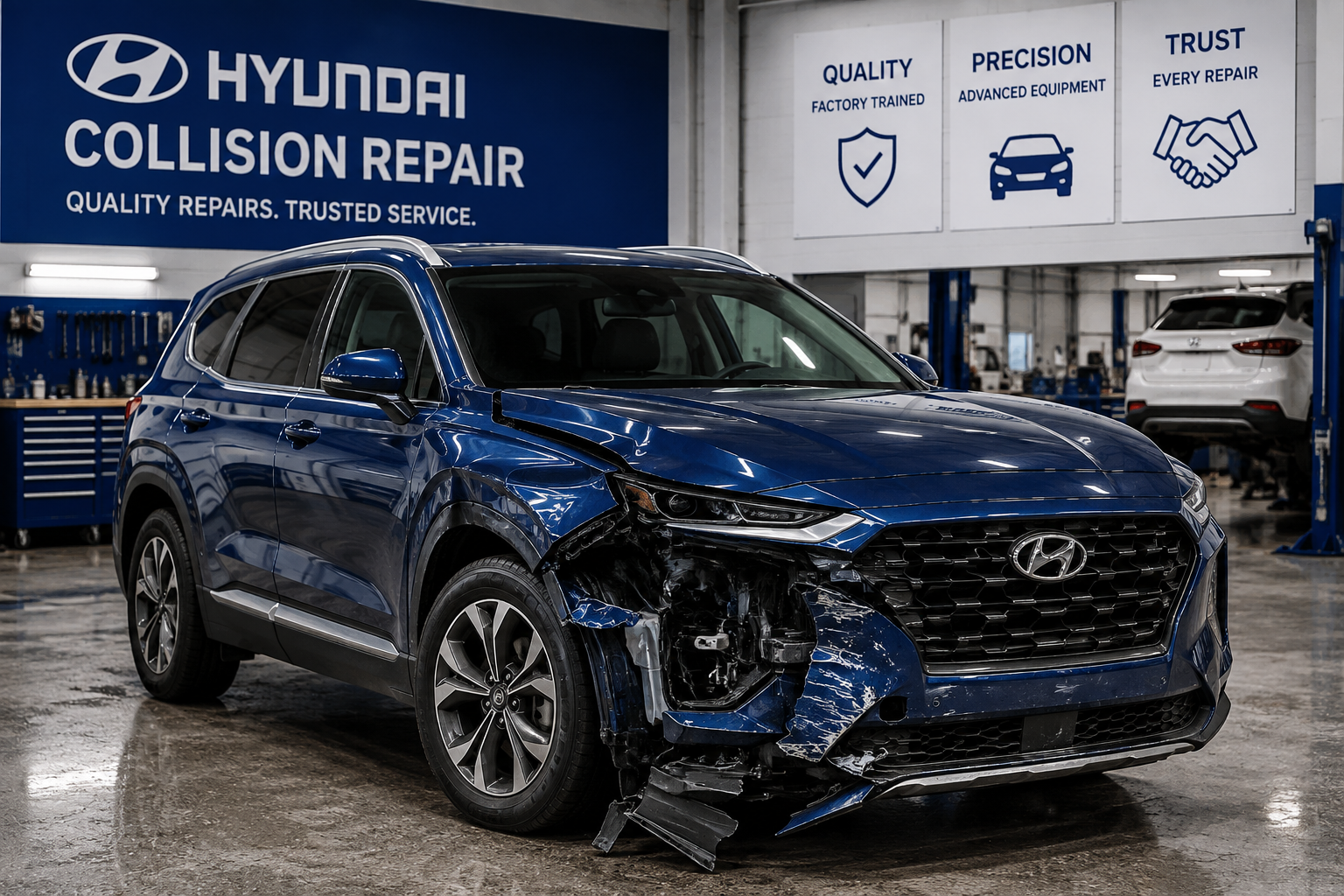
Hyundai Collision Shop Michigan
Professional Hyundai collision and auto body repair built around careful damage analysis, quality workmanship, modern vehicle technology and attention to the complete repair.
When your Hyundai has been involved in an accident, the repair may involve much more than the body panels you can see. Modern Hyundai vehicles can include high-strength structures, advanced restraint systems, cameras, radar, parking sensors, electronic modules, hybrid systems and high-voltage electric-vehicle components. Our goal is to evaluate the complete vehicle and develop a repair plan appropriate for the damage and the specific Hyundai being repaired.
Looking for a Hyundai Collision Shop Near You in Michigan?
The Collision Repair Shop provides Hyundai collision repair from our Ferndale, Michigan location for drivers throughout Metro Detroit and surrounding communities. Whether your Hyundai has minor exterior damage or significant accident damage, our team can evaluate the vehicle and explain the repair process.
Professional Damage Analysis
We inspect the visible collision damage and surrounding areas that may have been affected by the impact.
Modern Repair Planning
Repair decisions should account for the specific Hyundai model, body construction, safety systems and vehicle technology.
Customer-Focused Service
We believe the vehicle owner should understand the repair process and know what is happening with their Hyundai.
Why Hyundai Owners Choose The Collision Repair Shop
A quality repair should give you confidence in more than the exterior appearance. We focus on the complete collision repair process from the first inspection through final delivery.
We Look Beyond Visible Damage
Collision forces can affect components behind bumpers, body panels, lights and interior trim.
We Treat Every Hyundai Individually
An Elantra, Palisade, Santa Cruz and IONIQ vehicle may require very different repair considerations.
We Take Structural Repairs Seriously
Structural measuring, joining procedures, material considerations and corrosion protection can all matter after a significant collision.
We Respect Vehicle Technology
Cameras, radar, sensors, modules, restraint systems and driver-assistance technology can be involved in modern collision repairs.
We Work With Insurance Companies
Our team assists customers with estimates, repair documentation, additional damage and supplements when appropriate.
We Focus on the Final Result
Panel fit, paint quality, reassembly, diagnostics and final inspection all contribute to a professional completed repair.
Complete Hyundai Collision & Auto Body Repair
Depending on the collision, a Hyundai repair may involve several body, structural, mechanical, electronic and refinishing operations.
Front-End Collision Repair
Bumpers, hoods, fenders, headlights, grille areas, cooling systems, suspension, structure and electronics may all be involved.
Rear-End Collision Repair
Rear repairs may involve bumpers, trunks, liftgates, quarter panels, rear body panels, sensors and structural components.
Side-Impact Collision Repair
Side-impact repairs may involve doors, rockers, pillars, quarter panels, restraint systems and internal structure.
Hyundai Bumper Repair
Bumper repairs can include covers, reinforcement, absorbers, brackets, sensors and surrounding components.
Hyundai Door Repair
Doors may require repair or replacement depending on the outer panel, shell, intrusion structure, hinges and collision damage.
Hyundai Fender Repair
Fender damage is evaluated along with surrounding bumper, hood, headlight and door alignment.
Quarter Panel Repair
Quarter panel damage may involve exterior repair, replacement considerations, adjoining panels and structural areas.
Structural Collision Repair
Structural areas can require measuring, repair planning, material identification and appropriate joining procedures.
Paint & Refinishing
Repaired panels are prepared, color matched and refinished using professional automotive refinishing procedures.
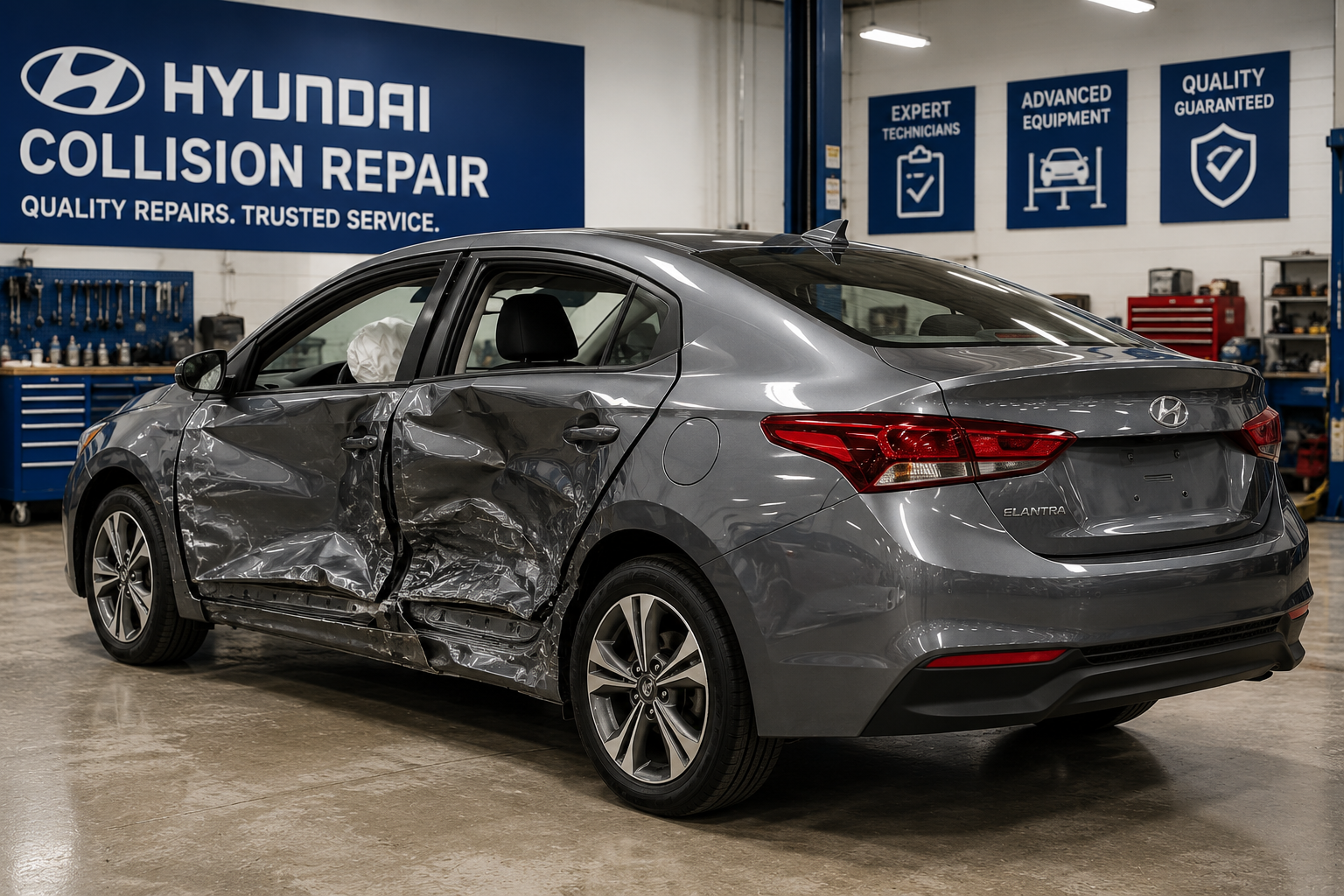
Severe Side Damage Can Affect Much More Than the Doors
A side-impact collision can crush exterior doors while also transferring force into rocker panels, pillars, floor structures and internal reinforcement.
Side airbags, seat-belt systems, wiring, sensors and electronic modules may also be involved depending on the severity and location of the collision.
Our Hyundai Collision Shop Michigan evaluates the entire impact area so the repair plan is not limited to replacing the visibly damaged door panels.
What You See After an Accident May Only Be Part of the Damage
Modern vehicle design can conceal structural, mechanical and electronic components behind exterior panels. Additional damage may become visible during a more detailed inspection or disassembly.
Bumper Reinforcement
Exterior bumper damage can conceal damaged reinforcement, energy absorbers, brackets and sensors.
Cooling Components
Front impacts can affect radiators, condensers, cooling fans, shutters and radiator support components.
Rocker & Pillar Damage
Severe side impacts can transfer force into structural areas behind the outer body panels.
Suspension Damage
Wheel-area impacts can affect control arms, struts, steering components, bearings, wheels and alignment.
Restraint Systems
Airbags, pretensioners, buckles, sensors and related systems may require evaluation after certain impacts.
Electronic Systems
Cameras, radar, parking sensors, wiring and control modules can be involved even when the exterior damage appears localized.
Structural Integrity Matters Where You Cannot See It
Collision forces can travel through rails, aprons, floor structures, rocker panels, pillars and other areas of the vehicle body.
Structural repair may require measuring, repair-versus-replacement decisions, material identification and specific joining procedures depending on the location and extent of the damage.
Proper structural condition also affects exterior fit. Hood, fender, door and liftgate gaps can provide important information about surrounding body alignment.
We believe the structural portion of a Hyundai repair deserves the same attention as the exterior paint and finish.
Diagnostic Scanning, Cameras, Radar & Driver Assistance Systems
Today's Hyundai vehicles can contain numerous electronic systems that may be affected by collision damage, disassembly, alignment, component replacement or other repair procedures.
Diagnostic Scanning
Diagnostic scanning may help identify electronic faults and system conditions before or after collision repair.
Forward Cameras
Windshield-mounted cameras can support lane, braking and other driver-assistance features.
Radar Sensors
Radar units located behind bumpers or other areas may be affected by impact damage or component replacement.
Blind-Spot Monitoring
Rear-quarter impacts can involve blind-spot sensors, brackets, wiring and surrounding components.
Parking Sensors
Bumper repairs can involve parking sensors that must be positioned correctly during reassembly.
Calibration
When calibration is required after applicable repairs, the necessary procedure should be completed before returning the vehicle to service.
Airbags & Seat Belts After a Hyundai Collision
Deployed airbags are an obvious sign that restraint systems were involved, but other restraint components can also be affected during a collision.
Airbags
Driver, passenger, side and curtain airbags may require evaluation when involved in a collision.
Seat-Belt Pretensioners
Pretensioners and related seat-belt components can activate during certain collisions.
Sensors & Modules
Impact sensors, wiring and restraint-system modules may require diagnostic evaluation.
Electric and Hybrid Hyundai Vehicles Require Additional Awareness
Hyundai's lineup includes gasoline vehicles, hybrids, plug-in hybrids and fully electric vehicles.
High-voltage batteries, orange high-voltage cabling, electric drive components, cooling systems and related electronics require additional consideration when collision damage or repair operations involve those systems.
An electric Hyundai should not simply be treated like a conventional gasoline vehicle. The repair plan should reflect the powertrain and configuration of the specific vehicle.
We Help You Navigate the Insurance Repair Process
When insurance is involved, the initial estimate may not represent the complete repair.
Additional collision damage can become apparent during a detailed inspection or after damaged components are removed.
When appropriate, our Hyundai Collision Shop Michigan can document additional damage and necessary repair operations for insurance review through the supplement process.
We believe customers should understand what is being repaired and why the repair plan changes when additional collision damage is discovered.
Our Hyundai Collision Repair Process
Every collision is different, but our goal is to move through the repair in an organized way so important damage and necessary procedures are not overlooked.
Initial Damage Inspection
We inspect the damaged area and surrounding components to begin developing the repair plan.
Vehicle Identification
The year, model, trim, equipment and powertrain can affect the collision repair.
Diagnostic Scanning
Applicable electronic systems may be scanned to identify collision-related faults.
Repair Planning
Repair-versus-replacement decisions and required operations are established.
Insurance Coordination
Insurance documentation and additional damage can be communicated during the claim process.
Disassembly & Hidden Damage Inspection
Damaged components may be removed when needed to identify concealed collision damage.
Body & Structural Repair
Approved body and structural repair operations are completed according to the repair plan.
Paint & Refinishing
Repaired panels are prepared, color matched and professionally refinished.
Reassembly & Related Procedures
Trim, lamps, sensors and other components are reinstalled and related procedures completed.
Final Quality Inspection
The repaired Hyundai is reviewed for completion, fit, finish, reassembly and overall repair quality.
Hyundai Collision Repair for Cars, SUVs, Hybrids & Electric Vehicles
We repair collision-damaged Hyundai vehicles across a wide range of models and configurations.
Hyundai Elantra
Front, rear and side-impact collision repair including doors, bumpers, structure, restraint systems and refinishing.
Hyundai Sonata
Collision repair involving front-end, rear body, doors, structural components, lighting and paint.
Hyundai Tucson
Repair for bumpers, hoods, fenders, doors, liftgates, quarter panels, sensors and structural areas.
Hyundai Santa Fe
Collision and auto body repair for front, rear and side impacts and related safety systems.
Hyundai Palisade
Collision repair involving large SUV body panels, doors, liftgates, structure, sensors and restraint systems.
Hyundai Kona
Repair of bumpers, fenders, hoods, doors, quarter panels and other accident-related components.
Hyundai Venue
Auto body and collision repair for exterior panels, bumpers, doors, liftgates and related damage.
Hyundai Santa Cruz
Collision repair involving front-end components, doors, bed areas, tailgate and surrounding structure.
Hyundai IONIQ 5
EV collision repair with consideration for high-voltage systems, structure, electronics and driver-assistance technology.
Hyundai IONIQ 6
Collision repair involving body, structural, electronic, sensor and high-voltage-system considerations.
Hyundai IONIQ 9
Collision repair evaluation involving EV body panels, structure, electronics, high-voltage components and safety systems.
Other Hyundai Models
Contact our team about collision repair for other Hyundai models, configurations and model years.
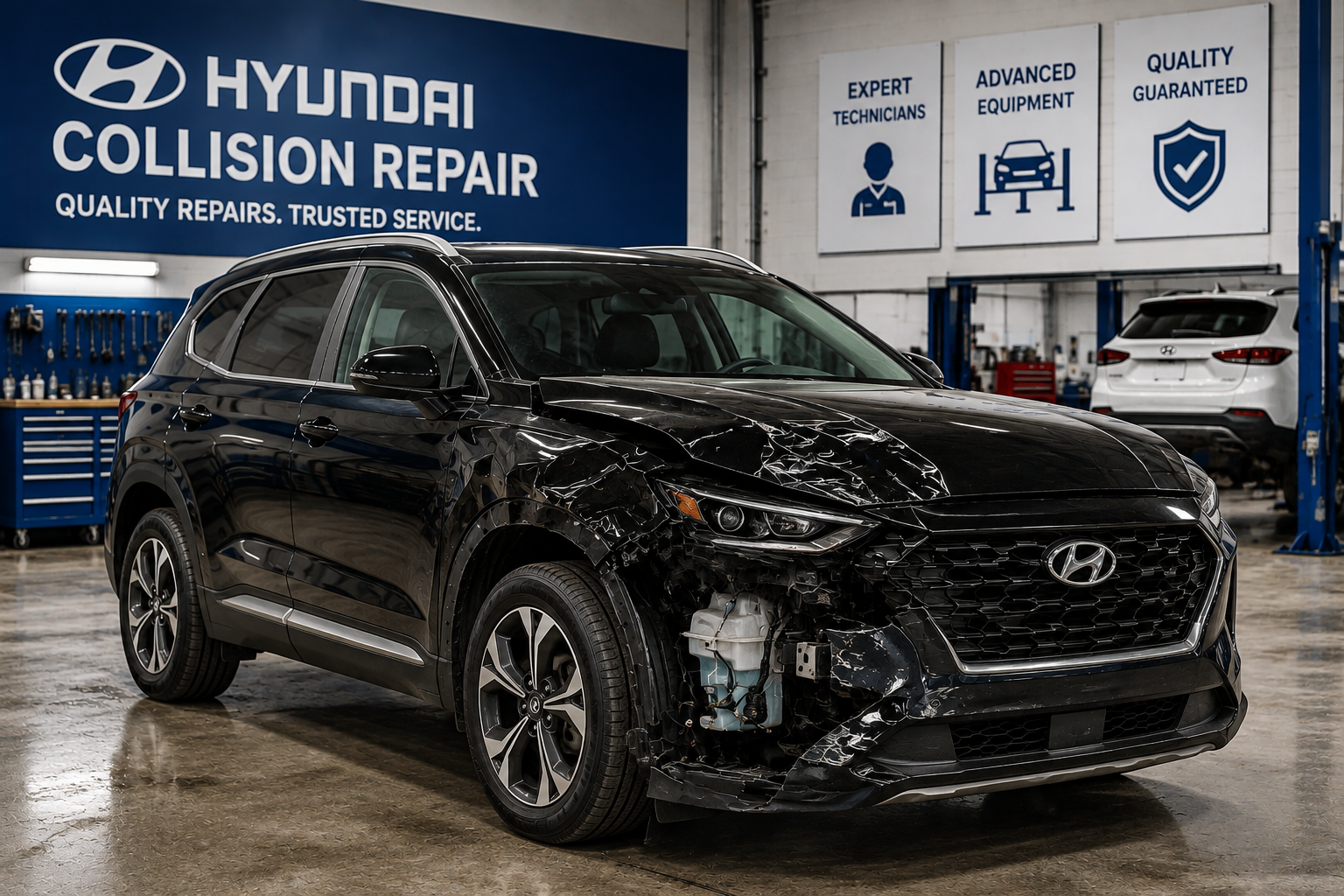
A Quality Hyundai Repair Is More Than Replacing the Parts You Can See
Severe front-end damage may involve the bumper, hood, fender and headlight, but it can also affect cooling systems, structural components, suspension, steering, sensors and wiring underneath.
Our repair approach is designed around the complete damaged area so important components are not overlooked simply because they are hidden after reassembly.
The goal is not to make the accident disappear quickly. The goal is to complete the repair carefully and professionally.
Hyundai Collision Shop Michigan FAQ
Detailed answers to common questions Hyundai owners may have after an accident.
Do you repair all Hyundai models?
We repair a wide range of Hyundai cars, SUVs, hybrids and electric vehicles including Elantra, Sonata, Tucson, Santa Fe, Palisade, Kona, Venue, Santa Cruz and IONIQ models.
Where is your Hyundai Collision Shop Michigan located?
The Collision Repair Shop is located at 836 E 9 Mile Rd, Ferndale, Michigan 48220. Call (248) 545-4600.
Do you work with insurance companies?
Yes. We assist customers with insurance estimates, claim documentation, additional collision damage, supplements and repair communication.
What if the insurance estimate misses some of the damage?
Additional collision-related damage or required operations may become apparent during a detailed inspection or disassembly and can be documented for insurer review.
What is an insurance supplement?
A supplement is additional repair documentation prepared when collision-related damage or operations are identified that were not included in the original insurance estimate.
Can hidden damage be found after my Hyundai is taken apart?
Yes. Exterior components can conceal structural, mechanical and electronic damage that may not be visible during the initial inspection.
Do you repair Hyundai front-end collision damage?
Yes. Front repairs may involve bumpers, hoods, fenders, headlights, grille areas, cooling components, structure, suspension and electronics.
Do you repair Hyundai rear-end collision damage?
Yes. Rear repairs may involve bumper systems, trunks or liftgates, quarter panels, taillights, rear body structure and sensors.
Do you repair Hyundai side-impact damage?
Yes. Side-impact damage can involve doors, rocker panels, pillars, quarter panels, airbags, seat belts and structural components.
Can you repair a Hyundai with deployed airbags?
A Hyundai with deployed airbags requires evaluation of affected airbags, seat belts, pretensioners, sensors, wiring and restraint-system modules.
Do you repair Hyundai structural damage?
Structural damage can be evaluated and repaired depending on the vehicle, location, material and severity of the collision damage.
How do you know if my Hyundai has structural damage?
Severe impact damage, abnormal panel gaps, door alignment issues and visible deformation can indicate the need for additional structural inspection or measuring.
Do Hyundai vehicles need diagnostic scanning after an accident?
Modern Hyundai vehicles contain numerous electronic modules. Diagnostic scanning may be appropriate before or after repairs depending on the collision and repair procedures.
Can collision damage affect Hyundai cameras and radar?
Yes. Cameras, radar sensors, parking sensors and related brackets and wiring can be affected by impacts or repair operations.
Does my Hyundai need ADAS calibration?
Calibration requirements depend on the vehicle equipment and repairs performed. Certain camera, radar, steering, suspension or body repairs may require calibration procedures.
Do you repair Hyundai electric vehicles?
We can evaluate collision-damaged Hyundai electric vehicles, including IONIQ models, with consideration for high-voltage systems, battery protection and electronics.
Do you repair Hyundai hybrids?
Yes. Hybrid collision repairs may involve additional considerations around high-voltage components and hybrid systems depending on the damage location.
Do you repair Hyundai bumpers?
Yes. Hyundai bumper repair may involve the bumper cover, reinforcement, absorber, brackets, retainers, sensors and adjoining components.
Can a Hyundai door be repaired instead of replaced?
That depends on the location, severity, material and condition of the door structure. The proper repair method is determined after inspection.
Do you repair Hyundai paint damage?
Yes. Repairs may include surface preparation, color matching, basecoat, clear coat and professional refinishing.
Can you match Hyundai metallic and pearl paint?
Metallic and pearl finishes require careful color evaluation and refinishing technique to achieve a proper appearance.
How long does Hyundai collision repair take?
Repair time depends on damage severity, parts availability, insurance approvals, structural work, refinishing, diagnostics, calibration and other required operations.
Can I send photos for a Hyundai collision estimate?
Yes. Photos can help with a preliminary review, but some collision damage cannot be accurately identified until the vehicle receives a physical inspection.
Can I pay out of pocket instead of using insurance?
Yes. Customers may request an estimate and choose to pay directly for eligible collision or body repairs.
Do you repair smaller Hyundai dents and scratches?
Yes. We can evaluate smaller collision-related dents, scratches, scuffs and body damage in addition to major accident repairs.
Can you help with towing?
Contact our team if the Hyundai is not safely drivable. We can discuss towing and the next steps for getting the vehicle to our facility.
Do you have transportation options while my Hyundai is repaired?
Loaner or transportation options may be available subject to restrictions and availability. Contact our team for details.
Why should I choose The Collision Repair Shop for my Hyundai?
Our approach emphasizes complete damage analysis, professional repair planning, structural and body repair, refinishing, diagnostics, insurance assistance, communication and attention to the entire vehicle.
Your Hyundai Should Be Repaired Around the Vehicle — Not Around the Fastest Shortcut
A quality collision repair is not measured only by how good the paint looks when the vehicle leaves the shop. Structural condition, hidden damage, safety systems, electronics, corrosion protection, panel fit, refinishing and final inspection all contribute to the completed repair. Our Hyundai Collision Shop Michigan believes every one of those details deserves attention.
Your Hyundai Deserves More Than a Repair That Simply Looks Good.
It deserves a collision shop that takes the entire vehicle seriously. From the first inspection to the final delivery, The Collision Repair Shop is here to provide professional Hyundai body repair, structural repair, refinishing, diagnostics, insurance assistance and the quality workmanship you expect when trusting someone with your vehicle.