Trusted Auto Body Repair in Detroit
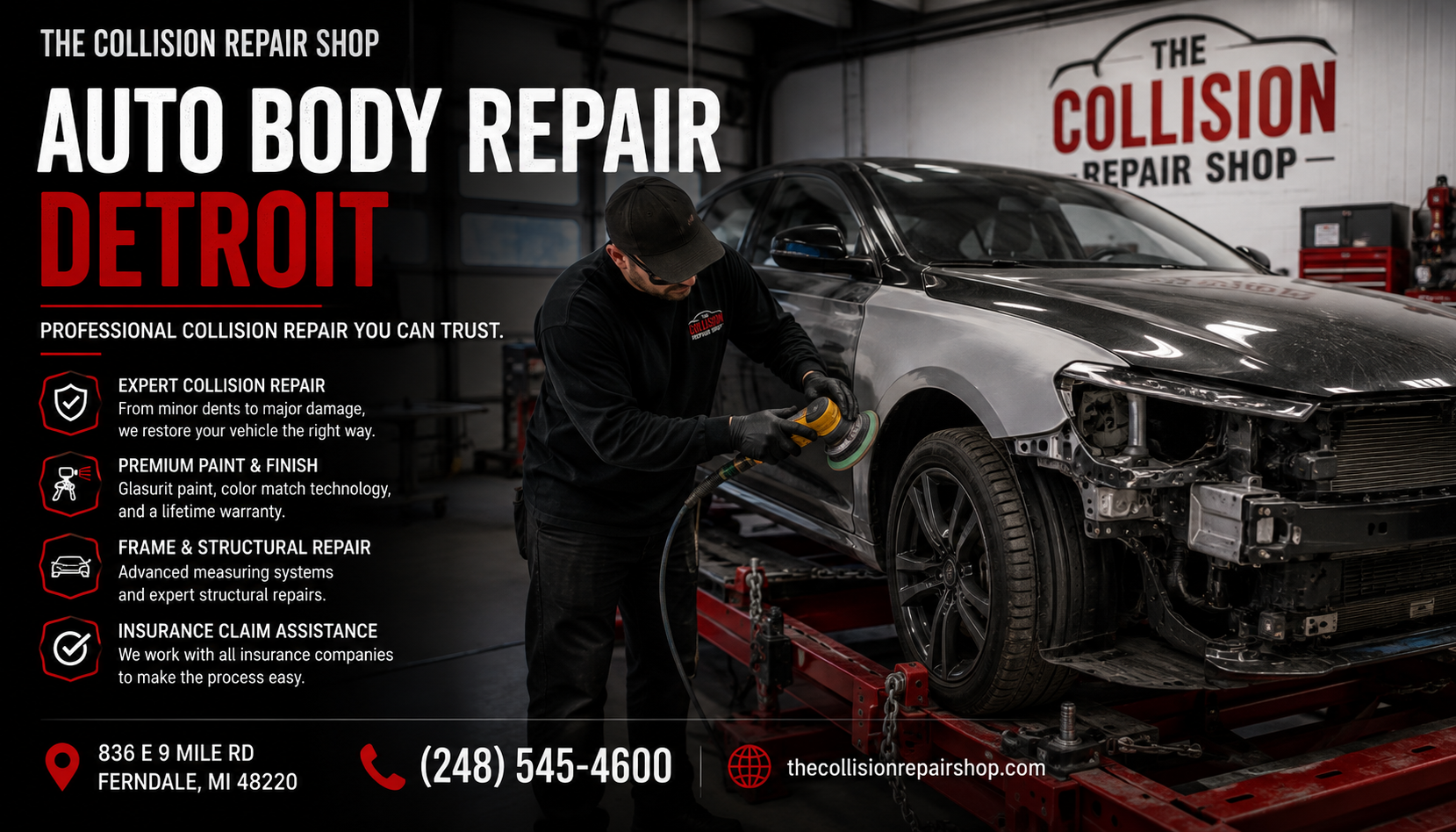
The Collision Repair Shop provides professional Detroit auto body repair for domestic, import, luxury, electric, and performance vehicles. From minor dents to major collision damage, our experienced technicians use advanced repair equipment and OEM repair procedures whenever applicable to restore your vehicle safely and professionally.
Detroit Auto Body Repair
From minor dents and paint damage to major structural collision repairs, The Collision Repair Shop provides professional Detroit auto body repair for domestic, import, luxury, electric, and performance vehicles.
Our experienced team uses advanced repair equipment, premium refinishing products, computerized measuring technology, and OEM repair procedures whenever applicable. We also help customers navigate estimates, insurance inspections, supplements, repair approvals, and vehicle updates throughout the process.
Professional Auto Body Repair in Detroit
Collision damage is not always limited to the areas visible from the outside. An impact may affect body panels, mounting brackets, reinforcement bars, structural components, suspension parts, steering systems, electrical components, cameras, radar sensors, glass, and safety equipment.
Our Detroit auto body repair process begins with a careful inspection of the vehicle and the visible damage. When authorized, damaged components may be removed so hidden damage can be documented and added to a complete repair plan.
Whether your vehicle needs cosmetic body work, bumper repair, paint refinishing, frame measuring, panel replacement, glass replacement, or extensive collision reconstruction, our goal is to provide an organized and professional repair experience.
Detroit Auto Body Repair Services
Our repair services cover minor cosmetic damage, major accident damage, structural concerns, refinishing, electronics, glass, and related mechanical repairs.
Collision Repair
Complete accident-damage inspection and repair for vehicles involved in minor, moderate, and major collisions.
Dent and Crease Repair
Repair of dents, creases, body-line damage, and distorted panels when repair is safe and appropriate.
Bumper Repair
Repair or replacement of front and rear bumper covers, reinforcements, absorbers, brackets, sensors, and trim.
Fender Repair
Professional repair or replacement of damaged front fenders, liners, moldings, mounting areas, and adjacent components.
Door Repair
Repair of damaged doors, hinges, intrusion beams, handles, regulators, glass, wiring, trim, and side-impact components.
Quarter-Panel Repair
Repair or replacement of damaged rear body panels, wheel openings, inner structures, seams, and adjoining panels.
Hood and Trunk Repair
Repair, alignment, replacement, refinishing, and latch inspection for damaged hoods, trunks, and liftgates.
Frame and Structural Repair
Computerized measuring and controlled structural repair for damaged frame and unibody components.
Automotive Painting
Surface preparation, computerized color matching, Glasurit refinishing, blending, clear coat, curing, and polishing.
Scratch and Paint Repair
Repair of clear-coat scratches, chipped paint, scuffs, exposed metal, peeling finishes, and collision-related paint damage.
Auto Glass Replacement
Windshield, door glass, back glass, quarter glass, mirror, regulator, and related trim replacement.
Diagnostic Scanning
Pre- and post-repair electronic scanning when applicable to identify trouble codes and verify system communication.
ADAS Calibration Coordination
Coordination of applicable camera, radar, steering-angle, and safety-system calibrations with a qualified provider.
Aluminum Body Repair
Material-specific inspection and repair planning for aluminum panels and structural components.
Insurance Claim Assistance
Assistance with estimates, photographs, inspections, supplements, approvals, documentation, and claim communication.
Types of Auto Body Damage We Repair
Parking-Lot Damage
Door dings, bumper scuffs, mirror damage, scratches, and body-panel dents caused by tight parking spaces and minor impacts.
Front-End Collision Damage
Damage involving bumpers, grilles, lamps, hoods, fenders, radiator supports, cooling systems, rails, and sensors.
Rear-End Collision Damage
Damage involving rear bumpers, liftgates, trunk floors, quarter panels, rails, exhaust components, and parking sensors.
Side-Impact Damage
Damage to doors, pillars, rocker panels, quarter panels, mirrors, glass, intrusion beams, seats, and restraint systems.
Structural Collision Damage
Movement or deformation of rails, pillars, aprons, floors, towers, crossmembers, and other structural areas.
Weather and Hail Damage
Dents, broken glass, paint damage, trim damage, and exterior panel concerns caused by hail, falling objects, or severe weather.
Hidden Damage After a Collision
Exterior damage may only show part of what happened during an accident. A bumper cover can return close to its original shape while brackets, absorbers, reinforcement bars, sensors, mounting points, or nearby structures remain damaged.
Hidden damage can also affect suspension, steering, cooling, air-conditioning, wiring, restraint systems, glass, and advanced driver-assistance equipment.
For this reason, an initial estimate may change after authorized disassembly. Any additional damage can be documented and submitted to the insurance company as a supplement when applicable.
Should a Damaged Panel Be Repaired or Replaced?
The correct decision depends on the vehicle, panel material, damage location, severity, accessibility, manufacturer limitations, and the condition of adjoining structures.
Panel Repair May Be Appropriate When
- The damage remains within repairable limits
- The panel can be restored without excessive filler
- Structural integrity is not compromised
- OEM procedures permit the repair
- The repair provides acceptable fit and appearance
Panel Replacement May Be Required When
- The panel is torn, cracked, stretched, or severely bent
- The damage reaches a restricted repair area
- Important mounting points are distorted
- Corrosion or previous repairs affect repairability
- The manufacturer requires replacement
Detroit Structural and Frame Repair
Modern vehicles are designed to manage collision energy through carefully engineered structures. Restoring damaged structural areas requires accurate measuring, proper equipment, controlled repair methods, and manufacturer repair information.
Computerized Measuring
Important structural points can be compared with vehicle specifications to identify movement and verify repair progress.
Frame and Unibody Repair
Controlled repair equipment is used when damaged areas are permitted to be restored rather than replaced.
Structural Component Replacement
Damaged rails, aprons, pillars, floors, crossmembers, and related components may require replacement.
Welding, Riveting, and Bonding
Repair methods depend on the vehicle’s construction materials and current OEM procedures.
Corrosion Protection
Primers, seam sealers, cavity protection, coatings, and material isolation help protect repaired areas.
Final Measurement Verification
Structural measurements may be reviewed after repair to confirm vehicle geometry.
Detroit Auto Body Paint and Color Matching
Professional refinishing requires more than selecting a paint code. Factory colors may contain several variants, and the vehicle’s existing finish can change over time because of sunlight, age, previous repairs, environmental exposure, and manufacturing differences.
Our refinishing process may include paint-code research, computerized formulas, color-variant review, test panels, blending, surface preparation, primer, basecoat, clear coat, curing, polishing, and final inspection.
We proudly use premium Glasurit automotive refinishing products to support color accuracy, appearance, durability, and a professional finish.
OEM Auto Body Repair Procedures
Vehicle manufacturers publish repair information addressing approved procedures, materials, replacement requirements, measurements, fasteners, welds, adhesives, scans, calibrations, and safety precautions.
Repair methods that were acceptable on an older vehicle may not be appropriate for a newer model using different steel, aluminum, adhesives, electronics, sensors, or structural designs.
ADAS Considerations During Auto Body Repair
Modern vehicles may use cameras, radar, ultrasonic sensors, steering-angle information, and electronic modules to support automatic braking, lane assistance, blind-spot monitoring, parking assistance, adaptive cruise control, and other driver-assistance features.
Repairs involving windshields, bumpers, grilles, mirrors, body panels, suspension, steering, alignment, or structural mounting points may require inspection, diagnostic scanning, initialization, aiming, or calibration.
When applicable, The Collision Repair Shop coordinates ADAS calibrations with a qualified calibration provider using vehicle-specific procedures and appropriate equipment.
Our Detroit Auto Body Repair Process
A structured repair process helps keep damage analysis, insurance communication, repairs, refinishing, and quality control organized.
Initial Estimate
We inspect visible damage, identify obvious concerns, and prepare an initial written estimate.
Insurance Coordination
Claim information, photographs, inspections, approvals, and initial repair documentation are organized.
Vehicle Disassembly
Damaged areas may be disassembled when authorized so hidden damage can be identified.
OEM Procedure Research
Current manufacturer repair information is reviewed for the specific year, make, model, and damage.
Supplement Documentation
Additional damage and required operations are documented and submitted for review when applicable.
Structural and Body Repair
Approved structural, panel, mechanical, glass, and related repairs are completed.
Paint and Refinishing
Panels are prepared, color matched, painted, cured, and polished in a controlled refinishing environment.
Reassembly
Lamps, trim, glass, moldings, sensors, hardware, and other removed components are reinstalled.
Scanning and Calibration
Applicable diagnostic scans, alignments, road tests, and calibrations are completed or coordinated.
Final Quality Inspection
The completed repair is reviewed for fit, finish, function, warning indicators, cleanliness, and overall quality.
Vehicle Delivery
The completed repair, applicable documentation, warranty information, and care instructions are reviewed.
Detroit Insurance Auto Body Repair
Dealing with an insurance claim after an accident can be confusing and stressful. Our team helps organize the repair process and communicates with insurance carriers regarding estimates, inspections, documentation, supplements, repair approvals, and related questions.
Insurance estimates may not include all hidden damage or every manufacturer-required operation before the vehicle is disassembled. When additional damage is identified, a supplement may be prepared for the carrier’s review.
Our team also keeps customers informed about repair progress, parts, approvals, and other factors affecting the estimated completion date.
Choosing Your Detroit Auto Body Repair Shop
Customers should understand their options and select a repair facility they trust. Insurance processes and policy requirements can vary, but a vehicle owner generally has an important role in choosing where repairs are completed.
Choose a Shop You Trust
Consider experience, communication, repair procedures, equipment, warranty terms, and customer service.
Review the Repair Plan
Ask what damage was found, what parts are being repaired or replaced, and what manufacturer procedures apply.
Ask About Hidden Damage
Understand how additional damage will be documented and submitted after authorized disassembly.
Review Parts Options
Parts selection may depend on manufacturer requirements, availability, insurance coverage, condition, and customer authorization.
Understand Scans and Calibrations
Modern vehicles may require electronic diagnostics and calibration following certain repairs.
Request Written Warranty Information
Review applicable workmanship, paint, part, and manufacturer warranty terms.
Vehicle Manufacturers We Repair
Our technicians repair many vehicle makes and models. Repair requirements vary by model year, construction materials, technology, and manufacturer procedures.
Luxury and Electric Auto Body Repair
Luxury Vehicle Repair
Luxury vehicles may require precise panel fit, specialized materials, complex electronics, advanced refinishing, and vehicle-specific repair procedures.
Electric Vehicle Repair
Electric vehicles may require high-voltage precautions, battery-area inspection, diagnostic scanning, specialized lifting procedures, and calibration of advanced safety systems.
Performance and Exotic Vehicles
Performance vehicles may use aluminum, carbon fiber, composites, high-strength steel, structural adhesives, and sophisticated electronics.
Why Choose The Collision Repair Shop?
Detroit Auto Body Repair Questions
Do you provide free auto body repair estimates?
Yes. Contact our team to schedule a free written collision repair estimate. Additional hidden damage may be found after authorized disassembly.
Do you work with insurance companies?
We work with major insurance carriers and assist with estimates, photographs, inspections, supplements, approvals, and repair communication.
Can I choose my own auto body repair shop?
Customers generally have an important role in selecting their repair facility. Policy and claim circumstances can vary, so ask your carrier about any specific requirements.
Do I need more than one estimate?
Requirements can depend on the claim or policy. You can identify the repair shop you prefer and ask your insurance company how it will inspect and process the damage.
How long will my auto body repair take?
Timing depends on damage severity, parts availability, insurance approval, manufacturer procedures, structural work, refinishing, scans, calibrations, and additional damage found during repairs.
Can you repair minor dents and scratches?
Yes. We repair many types of dents, creases, scratches, bumper scuffs, paint chips, and cosmetic collision damage.
Do you repair major structural damage?
We evaluate structural damage and use computerized measuring, repair equipment, and applicable manufacturer procedures to develop the repair plan.
Do you repair aluminum vehicles?
We evaluate and repair aluminum body panels and structures using material-specific procedures and specialized equipment whenever applicable.
Do you repair electric vehicles?
We repair electric vehicles and account for applicable high-voltage precautions, body construction, diagnostics, scanning, and calibration requirements.
Will my paint match the rest of the vehicle?
We use computerized formulas, color variants, test panels, technician experience, and blending when appropriate to achieve the closest practical match.
Do you use OEM parts?
Parts selection depends on manufacturer requirements, availability, insurance coverage, repairability, vehicle condition, and customer authorization.
What is an insurance supplement?
A supplement documents additional damage or required repair operations that were not included in the initial estimate.
Does my vehicle need diagnostic scanning?
Many modern vehicles may require pre- and post-repair scanning depending on manufacturer procedures, damaged systems, repairs performed, and diagnostic trouble codes.
Does my vehicle need ADAS calibration?
Calibration may be required when repairs affect cameras, radar, glass, bumpers, mirrors, steering, suspension, alignment, body panels, or structural mounting points.
Do you provide loaner vehicles?
Free loaner vehicles may be available to qualifying customers. Restrictions, eligibility requirements, and availability apply.
Do you provide a warranty?
Applicable written warranty coverage is provided, including a lifetime paint warranty subject to the stated terms and conditions.
How do I schedule an estimate?
Call The Collision Repair Shop at (248) 545-4600 or use our online contact form to request an estimate.
Need Professional Auto Body Repair in Detroit?
Contact The Collision Repair Shop for a free estimate, insurance claim assistance, OEM repair-procedure research, structural repair, premium refinishing, diagnostic scanning, and professional auto body repair.