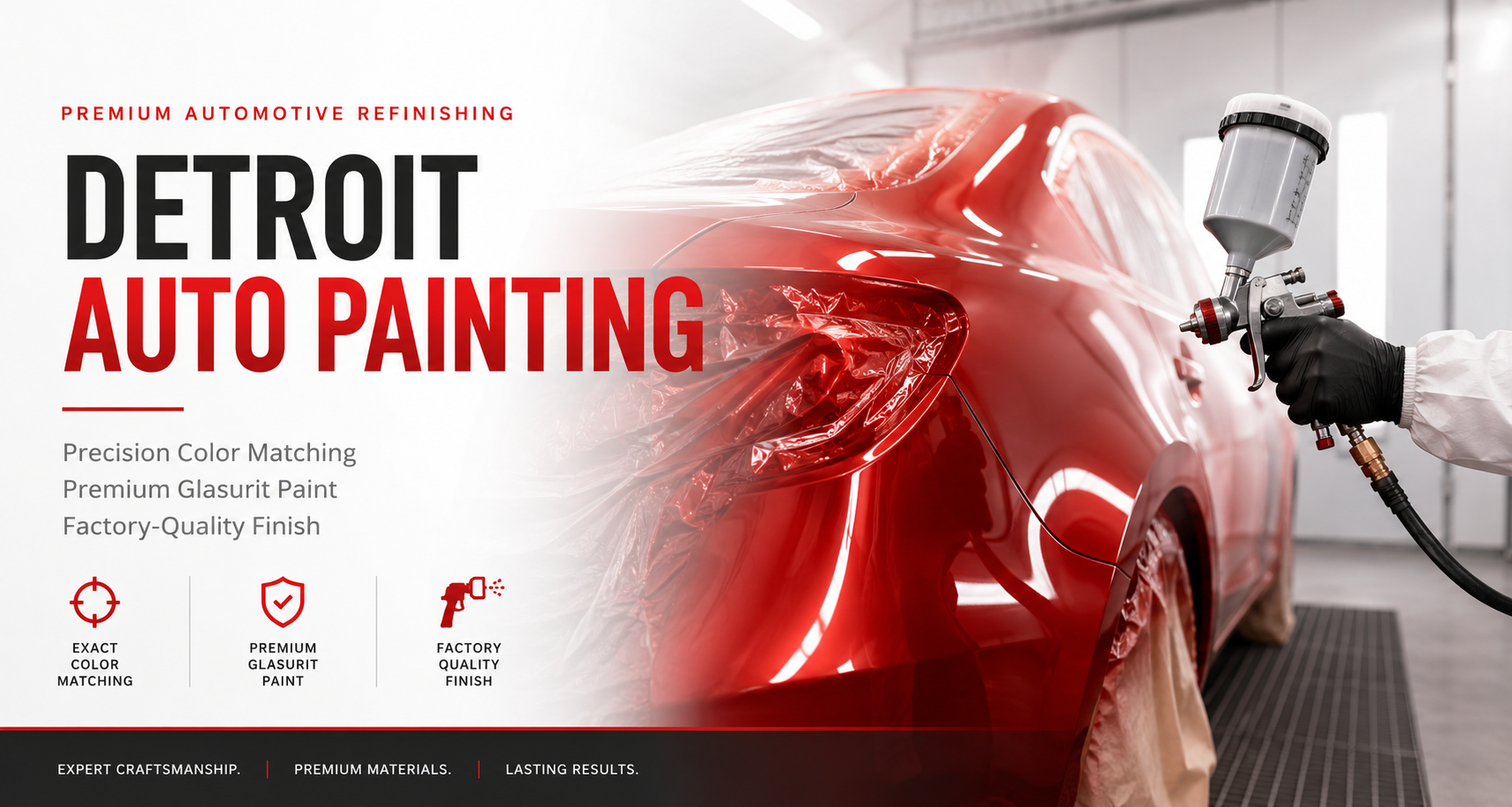
Detroit Auto Painting
Precision Color Matching. Factory-Quality Finishes.
Detroit Auto Painting That Brings Your Vehicle Back to Life
Automotive paint does much more than improve appearance—it helps protect metal surfaces from corrosion, weather, road debris, and everyday wear. Whether your vehicle has been involved in an accident, has fading paint, scratches, stone chips, or requires a complete refinish, achieving a professional finish requires careful preparation, premium materials, and experienced technicians.
At The Collision Repair Shop, every refinishing project begins with a thorough inspection of the damaged area. Surface preparation, panel alignment, masking, color verification, and finish evaluation all play an important role before any paint is applied. By focusing on each stage of the refinishing process, we help produce a clean, uniform finish with excellent color consistency and long-term durability.
Surface Preparation
Proper cleaning, sanding, feather edging, masking, and primer preparation create the foundation for a quality finish.
Color Verification
Computerized formulas and color variant selection help produce an accurate match before refinishing begins.
Controlled Application
Modern spray equipment and professional paint booth conditions help provide consistent coverage and finish quality.
Final Refinement
After curing, each painted surface is carefully inspected, polished when appropriate, and reviewed before delivery.
Detroit Auto Painting
Professional automotive paint repair, computerized color matching, collision refinishing, and premium Glasurit finishes for Detroit and Metro Detroit drivers.
The Collision Repair Shop refinishes domestic, import, luxury, electric, and performance vehicles. Whether your vehicle needs one repaired panel, paint blending after a collision, scratch repair, clear-coat restoration, or a larger refinishing project, our team carefully plans each stage of the work.
Professional Auto Painting in Detroit
Automotive paint does more than determine how a vehicle looks. A complete refinishing system also helps protect the underlying surfaces from moisture, corrosion, ultraviolet exposure, road chemicals, weather, and everyday use.
Producing a professional finish requires far more than spraying color onto a panel. The condition of the metal or plastic, previous repairs, sanding marks, primer, panel alignment, paint formula, spray technique, booth conditions, curing, and final polishing can all affect the result.
Our Detroit auto painting process is built around careful preparation and controlled application. Every project is evaluated individually so the refinishing plan matches the vehicle, damage, color, material, and repair being performed.
Detroit Auto Painting Services
Our automotive refinishing services cover collision-related paint damage, cosmetic defects, repaired panels, replacement parts, and complete exterior restoration needs.
Collision Paint Repair
Refinishing for panels repaired or replaced after an accident, including proper preparation, color matching, blending, clear coat, curing, and final inspection.
Panel Refinishing
Professional painting of repaired or replacement doors, fenders, hoods, quarter panels, bumpers, roofs, trunks, and liftgates.
Scratch Repair
Evaluation and repair of surface scratches, deeper paint damage, exposed primer, exposed metal, and clear-coat defects.
Paint Chip Repair
Repair of stone chips, edge chips, impact marks, and other small areas where the paint system has been damaged.
Bumper Painting
Preparation and refinishing of plastic bumper covers, including repaired areas, replacement covers, moldings, and applicable trim pieces.
Paint Blending
Controlled transition of color into an adjoining panel when needed to help produce a more consistent visual match.
Clear-Coat Repair
Inspection and repair planning for clear-coat scratches, oxidation, hazing, peeling, edge failure, and collision damage.
Full Vehicle Repainting
Larger refinishing projects for vehicles requiring broad exterior restoration, extensive color correction, or multiple-panel repainting.
Luxury Vehicle Refinishing
Careful refinishing for luxury and performance vehicles with complex colors, premium finishes, special materials, and precise panel presentation.
Electric Vehicle Painting
Automotive refinishing performed with consideration for electric-vehicle materials, sensors, cameras, charging components, and manufacturer repair information.
Commercial Vehicle Refinishing
Paint repair and refinishing for selected vans, work trucks, fleet vehicles, and commercial-use automobiles.
Post-Repair Polishing
Final surface refinement used when appropriate to improve clarity, remove minor texture concerns, and prepare the vehicle for delivery.
Computerized Automotive Color Matching
A factory paint code identifies a general color family, but it does not guarantee that every vehicle with that code appears exactly the same.
Why Paint Variants Exist
Manufacturers may produce several color variants under one paint code. Differences can result from production plants, supplier changes, spray conditions, application methods, model years, and factory adjustments.
The existing finish can also change because of age, sunlight, weather, polishing, previous repairs, chemical exposure, and environmental conditions.
Our Detroit Auto Painting Process
Initial Paint and Damage Inspection
We evaluate the panel condition, damage depth, previous repairs, paint failure, material type, color, and nearby panels.
Repair Planning
The refinishing plan is coordinated with required body repair, panel replacement, parts removal, insurance approval, and manufacturer procedures.
Cleaning and Decontamination
Wax, silicone, oil, road film, adhesives, and other contaminants are removed before sanding and refinishing.
Surface Repair
Dents, scratches, chips, damaged coatings, corrosion, and body-repair areas are addressed before primer is applied.
Feather Edging and Sanding
Damaged paint edges are carefully transitioned into stable surrounding material to create a smooth repair area.
Primer and Sealer Application
Appropriate primer and sealing products help prepare the repaired surface for uniform color and finish coverage.
Color Formula Verification
Paint-code information, color variants, test panels, and visual comparison are used to select the working formula.
Masking and Booth Preparation
The vehicle and surrounding areas are protected before the refinishing operation begins.
Basecoat Application
Color is applied using controlled spray technique, proper overlap, flash time, and material-specific procedures.
Clear-Coat Application
Clear coat provides gloss, depth, ultraviolet resistance, and protection for the color layer beneath it.
Controlled Curing
Paint materials are allowed to cure according to product, temperature, booth, and repair requirements.
Final Refinement and Inspection
The finish is reviewed for color, gloss, texture, cleanliness, coverage, edge quality, and overall appearance.
Glasurit Automotive Paint
The Collision Repair Shop uses premium Glasurit automotive refinishing products to support professional color matching, appearance, durability, and long-term finish quality.
A premium paint system still depends on correct surface preparation, spray technique, film thickness, flash time, curing, and final inspection. Each layer must work together as part of one complete refinishing process.
Downdraft Automotive Paint Booths
Controlled Airflow
Directed airflow helps move airborne particles away from the refinishing surface during paint application.
Dust Reduction
A dedicated booth environment helps limit contamination compared with painting in an open repair area.
Temperature Management
Controlled booth conditions support material application, flash times, curing, and consistent finish development.
Professional Lighting
Bright booth lighting helps technicians monitor coverage, color orientation, texture, and surface appearance.
Common Automotive Paint Damage
Scratches
Damage may remain in the clear coat or extend through the color, primer, or substrate.
Stone Chips
Road debris can remove the upper paint layers and expose primer, metal, or plastic.
Clear-Coat Peeling
Delamination may require removal of unstable material and broader refinishing than the visible edge suggests.
Fading
Sunlight, oxidation, age, and previous repair quality can change the original color and gloss.
Water-Spot Etching
Mineral deposits can remain on the surface or chemically etch into the clear coat.
Bird-Dropping Damage
Organic contamination can stain or etch paint when it remains on the surface for extended periods.
Chemical Staining
Fuel, harsh cleaners, solvents, industrial fallout, and road chemicals can affect finish appearance.
Collision Scuffing
Contact with another vehicle or object may leave transferred paint, scratches, cracks, and distorted underlying panels.
Previous Repair Failure
Poor adhesion, sanding marks, color mismatch, peeling, cracking, or shrinkage may indicate earlier refinishing problems.
Does the Vehicle Need Polishing or Repainting?
Polishing May Help When
- Damage remains within the clear coat
- The paint has light swirl marks
- The surface has mild oxidation or haze
- Water spots have not deeply etched the finish
- The color layer remains intact
Painting May Be Needed When
- Scratches penetrate the color layer
- Primer, metal, or plastic is exposed
- The clear coat is peeling or failing
- The finish is cracked, chipped, or chemically damaged
- Body repairs or replacement panels were completed
Painting Plastic Automotive Parts
Plastic bumper covers and exterior components require preparation that differs from metal panels. Surface type, flexibility, texture, contamination, previous paint, repair materials, and adhesion can all affect the refinishing plan.
Improper preparation can lead to peeling, lifting, cracking, edge failure, poor texture, or color inconsistency.
Metallic, Pearl and Multi-Stage Paint Colors
Some colors are more difficult to match because their appearance changes with spray technique, lighting, viewing angle, film thickness, particle orientation, and the number of applied layers.
Metallic Paint
Metallic particles can appear lighter, darker, coarser, or differently oriented depending on application technique.
Pearl Paint
Pearl pigments create visual depth and color movement that can change significantly under different lighting.
Tri-Coat Finishes
A separate ground coat, translucent effect coat, and clear coat may all influence the final color.
Matte and Satin Finishes
Low-gloss finishes require careful application because polishing can permanently change the intended sheen.
Insurance Auto Painting After an Accident
Collision-related refinishing is often part of a larger insurance repair involving body work, replacement parts, structural repairs, scans, calibrations, glass, trim, and mechanical operations.
Our team communicates with insurance companies regarding documented damage, refinishing operations, blending, necessary materials, repair procedures, and supplements when additional damage is discovered.
Vehicles We Refinish
How to Care for Fresh Automotive Paint
Follow Delivery Instructions
Cure times and care recommendations can vary by product, repair, temperature, and refinishing process.
Avoid Harsh Chemicals
Strong solvents, aggressive cleaners, and abrasive products can damage or dull the finish.
Use Proper Washing Methods
Clean wash mitts, automotive soap, gentle drying, and safe towels help reduce scratches.
Remove Contamination Promptly
Bird droppings, insects, fuel, tree sap, and road chemicals should not remain on the finish longer than necessary.
Avoid Brush Car Washes
Rotating brushes may create swirl marks and transfer debris from other vehicles.
Ask Before Applying Protection
Wax, sealant, coating, film, or other products should be applied according to the recommended curing period.
Why Choose The Collision Repair Shop?
Detroit Auto Painting Questions
Can you match my vehicle’s existing paint?
We use paint-code information, computerized formulas, color variants, test panels, visual comparison, and blending when appropriate to achieve the closest practical match.
Why are there several formulas for the same paint code?
Manufacturers may create several variants because of factory differences, supplier changes, model years, application methods, and production adjustments.
Will a newly painted panel look exactly like an older panel?
Age, ultraviolet exposure, weather, previous repairs, and surface condition can affect the existing finish. Blending may be recommended when a direct panel-to-panel match would be visually noticeable.
What is paint blending?
Blending gradually transitions color into an adjoining panel so the difference between the repaired color and existing finish is less noticeable.
Can scratches be polished instead of painted?
Light defects limited to the clear coat may improve through polishing. Scratches that reach the color, primer, metal, or plastic usually require paint repair.
Can peeling clear coat be repaired in one small spot?
Peeling often extends beyond the visible edge. Unstable material must be removed, and the repair may require refinishing a larger area or complete panel.
Can you paint a replacement bumper?
Yes. Replacement bumper covers require proper cleaning, preparation, adhesion procedures, color application, clear coat, and curing.
Can you paint over rust?
Painting directly over active corrosion does not correct the underlying problem. Rusted material must first be evaluated, removed, repaired, or replaced.
Can you repaint the entire vehicle?
Full or extensive vehicle refinishing can be evaluated based on the current paint condition, body damage, corrosion, disassembly needs, desired color, and expected result.
Can I change my vehicle’s color?
A complete color change requires substantially more disassembly and preparation than repainting the original color because door openings, jambs, edges, interior-facing surfaces, and hidden areas may need refinishing.
How long does automotive painting take?
Timing depends on body repairs, parts, panel count, color complexity, preparation, insurance approval, curing, polishing, and additional damage.
What causes paint to peel?
Peeling can result from poor adhesion, contamination, incorrect preparation, incompatible products, previous repairs, weather exposure, or clear-coat failure.
What causes orange peel in automotive paint?
Finish texture can be affected by spray technique, material viscosity, air pressure, temperature, reducer selection, flash time, and factory finish characteristics.
Can metallic paint be difficult to match?
Yes. Metallic orientation, particle size, spray distance, pressure, overlap, temperature, and viewing angle can change the appearance.
Does insurance cover auto painting?
Collision-related refinishing may be included when it is necessary to restore accident damage. Coverage depends on the claim, policy, repair plan, and carrier determination.
Do you use Glasurit automotive paint?
Yes. We use premium Glasurit refinishing products as part of our professional automotive paint system.
Do you provide a paint warranty?
We provide applicable written paint warranty coverage, subject to the stated terms, conditions, exclusions, and ownership requirements.
Can I wax the vehicle immediately after painting?
Follow the care instructions provided at delivery. The proper waiting period can vary according to products, curing conditions, and protective treatment.
Do you paint luxury and electric vehicles?
Yes. We refinish many domestic, import, luxury, performance, and electric vehicles while considering applicable manufacturer information and vehicle technology.
How do I request an auto painting estimate?
Call The Collision Repair Shop at (248) 545-4600 or submit your vehicle and damage information through our online contact form.
Need Professional Auto Painting in Detroit?
Contact The Collision Repair Shop for automotive paint repair, collision refinishing, computerized color matching, Glasurit paint, clear-coat repair, panel refinishing, and insurance claim assistance.