Professional Detroit ADAS Calibration Coordination
Today’s vehicles use cameras, radar sensors, steering-angle data, and other electronic systems to support features such as automatic emergency braking, lane assistance, adaptive cruise control, blind-spot monitoring, and parking assistance.
After certain collision repairs, windshield replacement, bumper work, suspension repairs, wheel alignment, or sensor removal, the vehicle may require inspection, diagnostic scanning, or ADAS calibration.
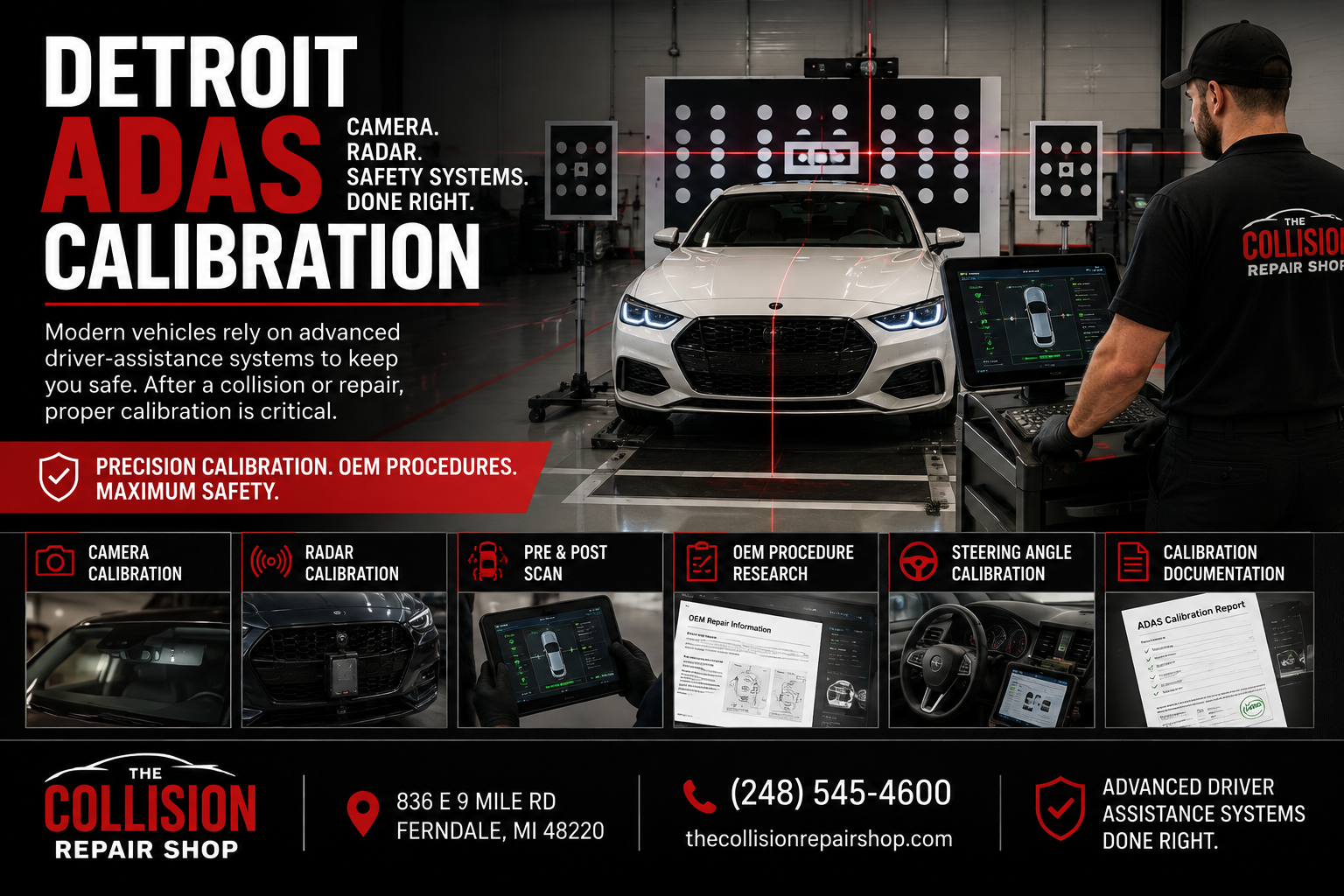
- Camera calibration coordination
- Radar calibration coordination
- Pre- and post-repair scanning
- OEM procedure research
- Calibration documentation
- Insurance claim assistance
Detroit ADAS Calibration Services
Modern vehicles rely on cameras, radar sensors, ultrasonic sensors, steering-angle information, and other electronic components to support important driver-assistance features. Following certain collision repairs, glass replacement, suspension work, wheel alignment, or sensor removal, these systems may require inspection or calibration.
The Collision Repair Shop helps Detroit and Metro Detroit drivers identify applicable ADAS requirements and coordinates professional calibrations with a qualified calibration provider. Our goal is to help ensure the repair process addresses the vehicle’s structural, mechanical, electronic, and safety-system requirements.
What Is ADAS Calibration?
ADAS stands for Advanced Driver Assistance Systems. These systems are designed to assist the driver with tasks such as maintaining distance, monitoring surrounding traffic, warning of lane departure, detecting objects, supporting emergency braking, and assisting with parking.
ADAS calibration is the process of aiming, positioning, initializing, or teaching applicable cameras and sensors according to the vehicle manufacturer’s procedures. The exact process depends on the year, make, model, equipment, damage, and repairs performed.
A successful scan alone does not automatically prove that every camera or sensor is aimed correctly. Likewise, the absence of a dashboard warning light does not necessarily establish that no calibration is required. That decision should be based on current manufacturer repair information for the specific vehicle.
Common Advanced Driver-Assistance Features
ADAS equipment and terminology vary by manufacturer. A vehicle may contain one or several of the following systems.
Forward Collision Warning
Warns the driver when the system detects a potential frontal collision with another vehicle or object.
Automatic Emergency Braking
May automatically apply braking when the system identifies an imminent frontal collision and the driver has not responded sufficiently.
Adaptive Cruise Control
Adjusts vehicle speed to help maintain a selected following distance from traffic ahead.
Lane Departure Warning
Alerts the driver when the vehicle appears to leave a detected lane without an intended turn signal input.
Lane-Keeping Assistance
May provide steering input or other assistance to help keep the vehicle within a detected traffic lane.
Blind-Spot Monitoring
Uses sensors to detect vehicles in areas that may be difficult for the driver to see through the mirrors.
Rear Cross-Traffic Alert
Warns of approaching vehicles or objects while the vehicle is reversing from a parking space or driveway.
Parking Assistance
Uses cameras and sensors to help detect nearby objects while maneuvering at lower speeds.
Surround-View Camera Systems
Combines images from multiple cameras to provide an enhanced view around the vehicle.
Traffic-Sign Recognition
Uses a forward-facing camera to identify certain road signs and display applicable information to the driver.
Driver-Monitoring Systems
May monitor driver attention, head position, eye movement, steering behavior, or other indicators depending on the vehicle.
Automatic High Beams
Uses camera information to help switch between high- and low-beam headlamps based on surrounding conditions.
Where ADAS Cameras and Sensors May Be Located
Driver-assistance components may be installed throughout the vehicle. Some are visible, while others sit behind exterior panels, glass, emblems, trim, mirrors, or interior components.
A bumper cover, grille, emblem, windshield, mirror, mounting bracket, or body panel may appear cosmetic while also serving as the mounting area or viewing path for an ADAS component.
When Might an ADAS Calibration Be Required?
Calibration requirements vary substantially by manufacturer and vehicle. The current OEM repair procedure must be reviewed before determining what is required.
Collision Damage
An impact may move a camera, sensor, bracket, body panel, structural component, suspension component, or mounting location.
Windshield Replacement
A forward-facing camera mounted to or viewing through the windshield may require calibration after glass replacement.
Camera or Sensor Replacement
Removing, replacing, disconnecting, or disturbing an ADAS camera or sensor may trigger a calibration or initialization requirement.
Bumper Repair or Replacement
Bumper work may affect parking sensors, blind-spot radar, rear cross-traffic sensors, brackets, or sensor viewing areas.
Grille or Emblem Replacement
Some radar units operate through a grille or manufacturer emblem that must meet specific installation requirements.
Wheel Alignment
Changes in alignment or steering geometry may require steering-angle initialization or calibration of applicable driver-assistance systems.
Suspension or Steering Repair
Replacement of certain suspension or steering components can change vehicle geometry or electronic reference values.
Ride-Height Changes
Springs, tires, suspension work, loading conditions, or vehicle modifications can affect camera and radar aiming.
Structural Repair
Frame or unibody movement can alter sensor mounting points even when a sensor itself was not visibly damaged.
Mirror or Door Repair
Cameras and blind-spot components may be located in or near doors and side-view mirrors.
Diagnostic Trouble Codes
Certain ADAS-related fault codes may require diagnosis, repair, aiming, initialization, calibration, or a functional test.
OEM-Specified Events
A manufacturer may require calibration following procedures that do not appear directly related to a camera or sensor.
Static, Dynamic, and Combination Calibrations
Static Calibration
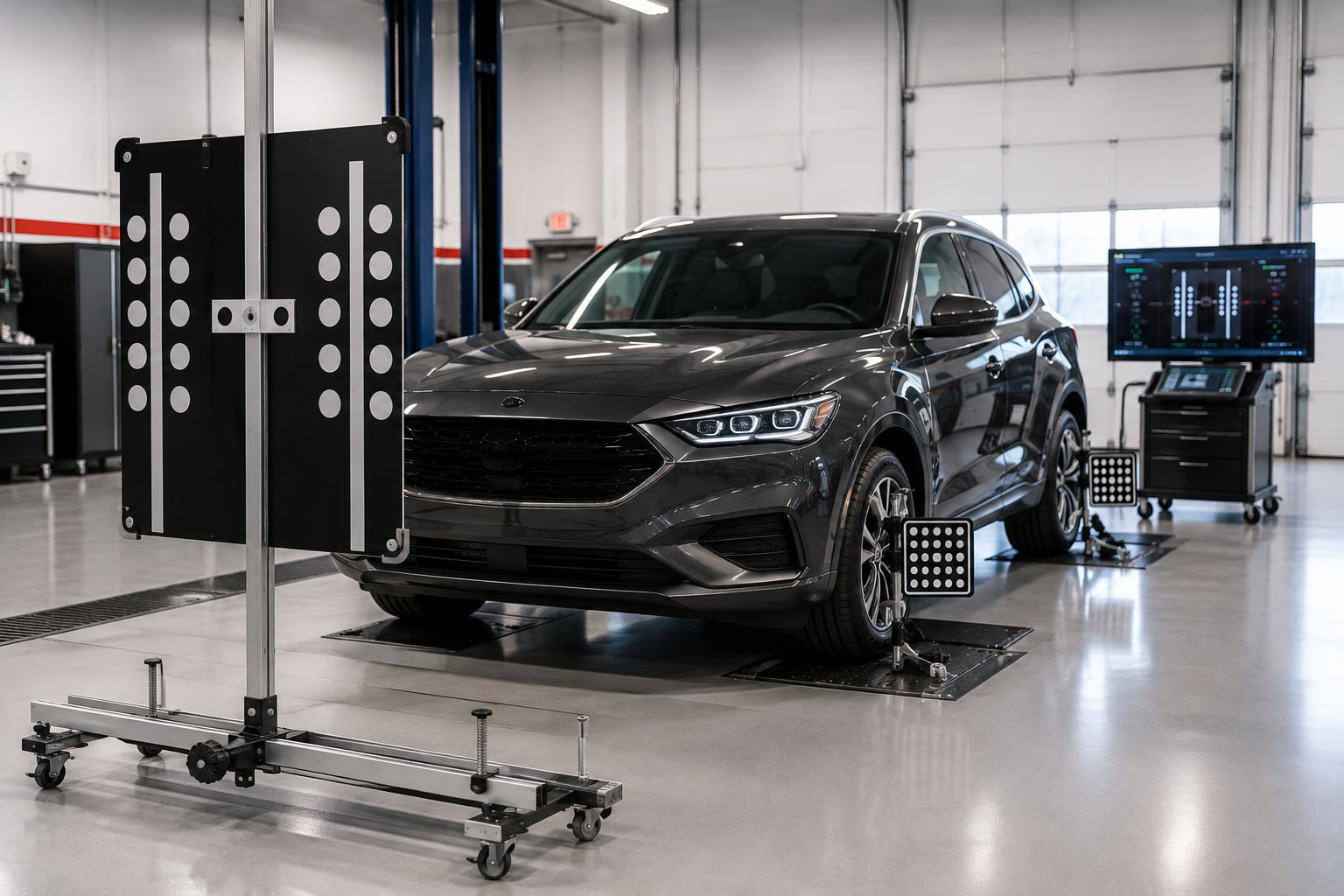
Static calibration is generally performed while the vehicle remains stationary. Vehicle-specific targets, reflectors, patterns, measuring tools, scan equipment, and controlled setup procedures may be required.
The calibration area may need a level floor, controlled lighting, specified distances, correct tire pressure, accurate wheel alignment, proper fuel or load conditions, and unobstructed space around the vehicle.
Dynamic Calibration
Dynamic calibration is generally performed while the vehicle is driven under manufacturer-defined conditions. The procedure may require specific road markings, vehicle speeds, distances, weather conditions, traffic conditions, and scan-tool commands.
The time needed can vary because the system may not complete its learning process until the required driving conditions are available.
Combination Calibration
Some vehicles require both a stationary target setup and a road-based learning procedure. Others require calibration of several individual cameras or sensors using different procedures.
The correct process is determined from current OEM information—not by selecting one universal calibration method for every vehicle.
Our Detroit ADAS Repair and Calibration Process
ADAS work should be integrated into the full collision repair plan rather than treated as an unrelated final step.
Vehicle Identification
We identify the year, make, model, trim level, vehicle options, and applicable driver-assistance equipment.
Damage Inspection
The vehicle is evaluated for visible collision damage, possible hidden damage, affected mounting areas, and related mechanical concerns.
Pre-Repair Diagnostic Scan
When applicable, a diagnostic scan helps identify stored trouble codes and electronic-system concerns before repairs begin.
OEM Procedure Research
Current manufacturer information is reviewed to identify repair, inspection, scanning, aiming, initialization, road-test, and calibration requirements.
Structural and Mechanical Repairs
Body, frame, suspension, steering, alignment, glass, and mounting-area repairs are completed before calibration when required by the repair plan.
Vehicle Preconditioning
Tire pressure, alignment, ride height, fuel level, battery condition, cargo, trouble codes, and other vehicle-specific prerequisites are addressed.
Calibration Coordination
We coordinate the required calibration with a qualified provider using appropriate equipment, targets, software, and vehicle-specific procedures.
Post-Repair Scan and Verification
Applicable systems are scanned and reviewed after repairs. Calibration completion and remaining trouble codes are documented.
Final Quality Review
The completed repair, supporting documentation, warning indicators, and applicable system requirements are reviewed before vehicle delivery.
Why Calibration Preconditions Matter
ADAS calibration is more than connecting a scan tool and pressing a button. Manufacturers may specify numerous conditions that must be satisfied before the procedure can begin or complete successfully.
Attempting calibration before body dimensions, wheel alignment, sensor mounting, ride height, glass installation, or electronic faults are corrected may produce a failed procedure or inaccurate result.
Diagnostic Scanning Is Not the Same as ADAS Calibration
Diagnostic Scanning
A diagnostic scan communicates with vehicle control modules to identify trouble codes, system information, and certain electronic conditions.
- Identifies stored diagnostic trouble codes
- Helps locate electronic-system concerns
- May verify module communication
- Supports pre- and post-repair documentation
ADAS Calibration
Calibration aims, initializes, or teaches a camera or sensor so the system can use the proper reference position or viewing area.
- Uses manufacturer-specific procedures
- May require targets or controlled driving
- Depends on correct vehicle geometry
- Produces separate completion documentation
ADAS Calibration Documentation
Proper documentation helps show what systems were evaluated, what procedures were performed, and whether the calibration completed successfully.
ADAS Service Coordination for Many Vehicle Manufacturers
Calibration procedures differ between brands, models, equipment packages, and model years. We research the applicable requirements for the specific vehicle being repaired.
ADAS Calibration After an Insurance Repair
Calibration, diagnostic scanning, wheel alignment, road testing, and related setup operations may need to be included in a complete collision repair plan.
When applicable, our team documents the manufacturer requirements and communicates with the insurance carrier regarding necessary procedures. If hidden damage or additional ADAS requirements are identified after disassembly, supplemental documentation may be prepared.
Detroit ADAS Calibration Questions
Does every collision require ADAS calibration?
No. Calibration requirements depend on the vehicle, equipment, impact, damaged components, and repairs performed. Current OEM procedures should be reviewed for the individual vehicle.
Can a minor accident affect ADAS equipment?
Yes. A lower-speed impact can damage or move a sensor, bracket, bumper, grille, mirror, wheel, suspension component, or body mounting point even when the exterior damage appears limited.
Does replacing a windshield require calibration?
Many vehicles require calibration of the forward-facing camera after windshield replacement. The exact requirement depends on the manufacturer and vehicle.
Will an ADAS warning light always appear?
Not necessarily. A system may not display an obvious warning in every condition. Calibration requirements should not be determined solely by whether a warning light is present.
Is a diagnostic scan the same as calibration?
No. A scan checks electronic modules and trouble codes. Calibration aims, initializes, or teaches applicable cameras and sensors according to manufacturer procedures.
Can calibration be performed before an alignment?
Some manufacturers require correct wheel alignment and steering geometry before calibration. The required sequence depends on the OEM procedure.
How long does ADAS calibration take?
Timing varies by vehicle, number of systems, calibration type, setup requirements, road conditions, diagnostic concerns, and whether the procedure completes successfully on the first attempt.
Can weather affect a dynamic calibration?
Yes. Rain, snow, poor visibility, faded lane markings, traffic, road construction, and unsuitable road conditions may prevent a dynamic procedure from completing.
Can aftermarket modifications affect ADAS?
Changes to ride height, wheels, tires, suspension, bumpers, grilles, glass, lighting, or body components may affect system operation or calibration eligibility.
Does bumper paint affect radar or sensors?
Some sensor viewing areas have specific material, repair, film-thickness, refinishing, or replacement requirements. The applicable manufacturer procedure must be reviewed.
Who performs the calibration?
The Collision Repair Shop coordinates applicable calibrations with a qualified calibration provider using appropriate equipment and manufacturer-specific procedures.
Will I receive calibration documentation?
Available completion and scan documentation can be included with the repair records when applicable.
Does insurance pay for ADAS calibration?
Coverage depends on the claim, policy, damage, repair plan, and carrier determination. Our team can document applicable OEM requirements and communicate with the insurer.
Can I drive with an ADAS warning message?
A warning may mean that a system is limited, unavailable, or malfunctioning. Follow the vehicle manufacturer’s warnings and operating instructions and have the condition inspected.
Do electric vehicles require ADAS calibration?
Electric vehicles may use multiple cameras, radar units, ultrasonic sensors, and electronic safety systems. Their calibration requirements remain vehicle- and repair-specific.
Does Your Vehicle Need ADAS Calibration After a Collision?
Contact The Collision Repair Shop for a professional damage inspection, OEM repair-procedure research, diagnostic scanning, insurance assistance, and ADAS calibration coordination.