Professional Detroit Aluminum Body Repair
Modern vehicles increasingly use aluminum body panels and structural components to reduce weight while improving strength and fuel efficiency. Aluminum repairs require specialized tools, repair procedures, and trained technicians that differ from traditional steel repairs.
At The Collision Repair Shop, we provide professional Detroit aluminum body repair using OEM repair procedures whenever applicable, advanced repair equipment, and proven repair techniques to restore domestic, import, luxury, electric, and performance vehicles safely and professionally.
Detroit Aluminum Body Repair
Aluminum vehicle construction requires specialized repair procedures, dedicated tools, proper contamination control, and technicians trained to work with lightweight automotive materials.
The Collision Repair Shop provides professional Detroit aluminum body repair for domestic, import, luxury, electric, and performance vehicles. Whenever applicable, we research and follow manufacturer repair procedures to help restore your vehicle’s structure, appearance, safety systems, and long-term performance.
Professional Aluminum Auto Body Repair in Detroit
Modern vehicles increasingly use aluminum body panels and structural components to reduce weight while improving strength, efficiency, handling, and performance. Aluminum may be found in hoods, doors, fenders, quarter panels, liftgates, roofs, truck beds, suspension components, and complete vehicle structures.
Repairing aluminum is different from repairing traditional steel. The metal responds differently to heat, pulling, welding, shaping, sanding, riveting, and bonding. Therefore, technicians must use appropriate tools, procedures, materials, and work areas for the specific vehicle and component.
At The Collision Repair Shop, every aluminum repair begins with a careful damage inspection and vehicle-specific repair planning. Our team evaluates visible damage, possible hidden damage, structural concerns, manufacturer requirements, and related electronic or safety-system operations.
How Aluminum Body Repair Differs From Steel Repair
Aluminum and steel can both provide strong vehicle structures, but they require different repair strategies and equipment.
Aluminum Repair
- Requires dedicated aluminum tools
- Needs careful heat management
- May use specialized welding equipment
- Frequently involves riveting and bonding
- Requires contamination control
- May have strict replacement requirements
- Uses manufacturer-specific repair procedures
Traditional Steel Repair
- Uses tools designed for steel construction
- Responds differently to pulling and reshaping
- May use resistance spot welding or MIG welding
- Has different corrosion-protection needs
- Requires material-specific sectioning procedures
- Must also follow applicable OEM information
- Cannot share every procedure with aluminum
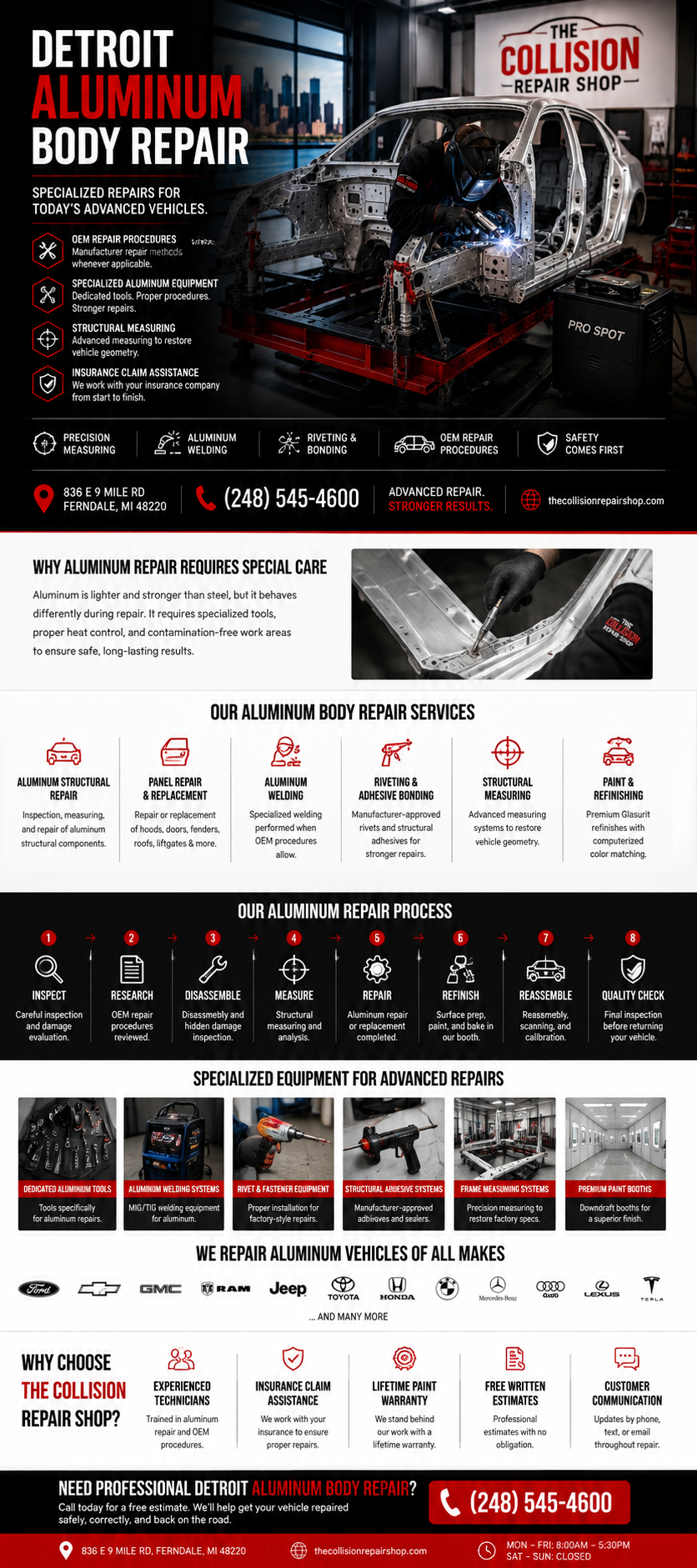
Detroit Aluminum Body Repair Services
Our repair plan may include one or several specialized operations depending on the vehicle and collision damage.
Aluminum Structural Repair
Inspection, measuring, repair, or replacement of aluminum structural components according to applicable manufacturer procedures.
Aluminum Panel Repair
Professional evaluation and repair of aluminum hoods, fenders, doors, quarter panels, roofs, liftgates, and other exterior panels when repair is permitted.
Aluminum Panel Replacement
Removal and installation of damaged aluminum components using the required fastening, bonding, welding, and corrosion-protection procedures.
Aluminum Welding
Specialized welding procedures performed when permitted by the vehicle manufacturer and appropriate for the material and repair location.
Riveting and Adhesive Bonding
Installation of approved rivets, structural adhesives, and fasteners according to manufacturer specifications and curing requirements.
Structural Measuring
Measuring important vehicle reference points to identify structural movement and verify repair progress.
Paint and Refinishing
Surface preparation, corrosion protection, premium Glasurit refinishing, computerized color matching, and controlled paint-booth application.
Diagnostic Scanning
Pre- and post-repair scanning when applicable to identify trouble codes and review electronic systems affected by the collision or repair.
ADAS Calibration Coordination
Coordination of applicable camera, radar, steering-angle, and safety-system calibrations with a qualified calibration provider.
Common Aluminum Vehicle Components
The amount and location of aluminum vary by manufacturer, vehicle model, equipment package, and model year.
Types of Aluminum Collision Damage We Evaluate
Dents and Creases
Aluminum dents require a different approach from steel due to the material’s strength, memory, and heat response.
Torn or Cracked Panels
Cracks and tears must be evaluated against manufacturer repair limitations before deciding whether repair or replacement is appropriate.
Structural Movement
Collision forces may move rails, pillars, aprons, towers, floors, and other structural reference points.
Corrosion or Contamination
Improper metal contact, damaged coatings, moisture, or steel contamination can affect the long-term durability of an aluminum repair.
Fastener and Bond Damage
Rivets, adhesives, welds, and factory joints may require inspection or replacement following an impact.
Sensor and Electronics Damage
Modern aluminum vehicles may contain cameras, radar, wiring, modules, and sensors near the damaged area.
Our Detroit Aluminum Repair Process
Each repair is planned around the vehicle’s construction, damage, manufacturer requirements, and applicable safety systems.
Initial Damage Inspection
We document visible damage and identify components that may require additional inspection or disassembly.
Vehicle Identification
The year, make, model, VIN, options, construction materials, and safety systems are reviewed.
OEM Procedure Research
Applicable manufacturer information is reviewed for repair limitations, replacement requirements, fasteners, adhesives, welding, measuring, and corrosion protection.
Disassembly and Hidden-Damage Inspection
Damaged areas are disassembled when authorized so hidden structural, mechanical, and electronic damage can be identified.
Structural Measuring
Important reference points are measured when needed to evaluate movement and develop the repair plan.
Aluminum Repair or Replacement
Approved repairs are completed using appropriate tools, equipment, parts, fasteners, adhesives, and material-specific procedures.
Corrosion Protection
Applicable coatings, seam sealers, primers, cavity protection, and isolation materials are restored.
Paint and Refinishing
Repaired surfaces are prepared, color matched, painted, and cured in a controlled refinishing environment.
Reassembly and System Verification
Components are reinstalled, electronic systems are reviewed, and applicable scans or calibrations are completed.
Final Quality Inspection
The completed vehicle is reviewed for fit, finish, operation, warning indicators, and overall repair quality before delivery.
Specialized Equipment for Aluminum Vehicles
Proper aluminum collision repair requires more than ordinary body-shop tools.
Dedicated Aluminum Hand Tools
Separate tools help reduce steel contamination and support material-specific repair methods.
Aluminum Welding Equipment
Specialized welding systems may be required for approved panel and structural procedures.
Rivet Installation Equipment
Manufacturer-approved rivets may require specific dies, pressures, installation tools, and access methods.
Adhesive Application Tools
Structural adhesives require correct preparation, mixing, bead size, installation time, and curing conditions.
Frame and Measuring Systems
Modern measuring and repair equipment helps evaluate and restore vehicle geometry.
Controlled Refinishing Equipment
Downdraft paint booths and computerized color systems support clean, durable, accurate finishes.
OEM Aluminum Repair Procedures
Manufacturers determine where aluminum components may be repaired, sectioned, welded, riveted, bonded, or replaced. These requirements may differ significantly between models produced by the same manufacturer.
Whenever applicable, our team reviews current OEM repair information for the specific vehicle. This helps determine the appropriate repair sequence, replacement boundaries, tool requirements, fastener types, adhesive procedures, measurements, heat limitations, and corrosion-protection operations.
Aluminum Vehicle Brands We Repair
Aluminum construction is found across many manufacturers and vehicle categories. Repair requirements depend on the specific model and component.
Detroit Aluminum Ford Truck Body Repair
Many late-model Ford trucks use aluminum body panels combined with high-strength steel frames. An accident may affect aluminum bedside panels, doors, fenders, hoods, cabs, structural joints, lighting, sensors, and the steel frame underneath.
Because these vehicles use mixed materials, the repair plan must account for the requirements of both aluminum and high-strength steel. Our team reviews applicable repair procedures before determining whether damaged parts should be repaired or replaced.
Luxury and Electric Vehicle Aluminum Repair
Luxury, performance, and electric vehicles often combine aluminum with high-strength steel, carbon fiber, composites, adhesives, castings, extrusions, and complex electronic systems.
Luxury Vehicles
Aluminum repair on luxury vehicles may require precise panel fit, specialized fastening systems, restricted repair areas, and detailed manufacturer procedures.
Electric Vehicles
Electric vehicles may require high-voltage safety precautions, battery inspection, isolation procedures, diagnostic scanning, and ADAS calibration in addition to aluminum body repair.
Performance Vehicles
Performance vehicles may use lightweight aluminum structures to improve handling and power-to-weight ratio. Restoring correct geometry is especially important.
Insurance Claims for Aluminum Body Repair
Aluminum repairs may involve specialized labor, dedicated equipment, manufacturer procedures, additional setup, corrosion protection, diagnostic scanning, alignment, and calibration operations.
Our team communicates with insurance carriers regarding the documented damage and required repair procedures. When additional damage is discovered during disassembly, we may prepare supplemental documentation for the insurance company’s review.
Why Choose The Collision Repair Shop?
Detroit Aluminum Body Repair Questions
Can every aluminum panel be repaired?
No. Repairability depends on the manufacturer, panel location, material type, damage severity, previous repairs, heat exposure, cracks, tears, and structural requirements.
Why does aluminum repair cost more than steel repair?
Aluminum repair may require specialized equipment, dedicated tools, additional setup, material-specific training, contamination control, rivets, adhesives, and more detailed manufacturer procedures.
Can steel tools be used on aluminum panels?
Dedicated aluminum tools are generally used to reduce the possibility of steel contamination and to support proper aluminum repair techniques.
Does aluminum rust?
Aluminum does not rust in the same way as steel, but it can oxidize and experience galvanic corrosion when improperly repaired or placed in contact with incompatible materials.
Can an aluminum panel be welded?
Some aluminum components may be welded when the manufacturer permits it. Other areas may require replacement, riveting, bonding, or a combination of procedures.
What is galvanic corrosion?
Galvanic corrosion can occur when dissimilar metals contact each other in the presence of moisture or another electrolyte. Proper isolation and corrosion protection are important during repair.
Do aluminum repairs require special paint?
The refinishing process requires appropriate surface preparation, primers, sealers, corrosion protection, and paint products compatible with the repaired substrate.
Can you repair aluminum Ford trucks?
We evaluate aluminum Ford truck collision damage and review applicable manufacturer procedures for body-panel, structural, frame, electronic, and safety-system repairs.
Do aluminum electric vehicles require special precautions?
Electric vehicles may require high-voltage safety procedures, battery inspection, diagnostic scanning, manufacturer-specific repair planning, and calibration of advanced safety systems.
Will insurance cover aluminum body repair?
Coverage depends on the insurance policy, claim, damage, repair plan, and carrier determination. We help document the required repairs and communicate with the insurer.
Does aluminum damage always show on the outside?
No. Collision forces can travel behind exterior panels and affect reinforcements, mounting points, structures, suspension, wiring, sensors, and electronic systems.
Do aluminum repairs require ADAS calibration?
Calibration may be required when repairs affect cameras, radar sensors, bumpers, mirrors, steering, suspension, alignment, glass, or structural mounting locations.
How long does aluminum body repair take?
Repair time depends on damage severity, parts availability, insurance approval, manufacturer procedures, structural work, refinishing, scanning, alignment, and calibration requirements.
Do you provide a warranty?
We provide applicable written warranty coverage, including a lifetime paint warranty subject to the stated terms and conditions.
How do I schedule an estimate?
Call The Collision Repair Shop at (248) 545-4600 or use our online contact form to request a professional collision repair estimate.
Need Professional Detroit Aluminum Body Repair?
Contact The Collision Repair Shop for a free estimate, insurance claim assistance, OEM repair-procedure research, structural measuring, premium refinishing, and professional aluminum collision repair.